Coaching vs Therapy for Relationship Patterns: Which Support Is Right for You?
You can understand your relationship pattern and still feel unsure what kind of help you need.
Maybe you become consumed by unavailable people, overgive, wait for mixed signals to become clarity, or pull away when closeness becomes real. You may wonder whether coaching can help you choose differently, whether therapy is needed, or whether couples therapy or psychiatry belongs in the conversation.
Therapy is not only for the past, and coaching is not only for the future. The better question is this:
Do you need clinical treatment, practical application, relationship repair, medical care, or some combination of these?
The right support should meet the depth of the problem without turning every human struggle into a diagnosis or treating serious symptoms as a mindset issue.
Coaching vs. Therapy at a Glance
Relationship coaching usually centers on awareness, decisions, goals, practice, and accountability. The International Coaching Federation defines coaching as a partnership that helps clients draw out their possibilities and potential. In relationship coaching, that may mean seeing an attraction pattern clearly, practicing a boundary, changing how you respond to uncertainty, or choosing reciprocity over fantasy.
Therapy is licensed mental health care. It can help people work with emotional distress, trauma, mental health conditions, behavior, relationships, and daily functioning. The American Psychiatric Association explains that psychotherapy may be used alone or with medication. It may examine earlier experiences, but it can also focus on what is happening now.
Both can create change. They simply carry different responsibilities, limits, and tools.
What Relationship Coaching Can Help You Do
Relationship coaching may fit when you are stable enough to reflect, make choices, and practice new behavior outside your sessions.
In my coaching work, insight is not the finish line. You may understand your pattern and still abandon your own boundary. Coaching helps move you from knowing to doing through work such as the following:
Separating chemistry from compatibility
Naming needs without apologizing for them
Setting a boundary and staying with the discomfort
Slowing the pace of a new relationship
Noticing when fantasy has replaced evidence
Building standards for reciprocity
A sound coaching relationship also needs clear limits. The ICF Code of Ethics calls for honesty about roles, qualifications, and boundaries. Its referral guidance says a coach should refer a client when the person’s needs fall outside the coach’s skill or coaching scope.
Coaching does not replace diagnosis, psychotherapy, trauma treatment, crisis care, or medication management.
What Therapy Can Help You Address
Therapy may be the stronger starting point when a relationship pattern is tied to significant distress, trauma symptoms, a mental health condition, or difficulty functioning.
Therapy may be needed when longing disrupts sleep or work, or when conflict brings panic, numbness, dissociation, or despair. It can offer clinical assessment and treatment for anxiety, depression, trauma, mood disorders, grief, compulsive behavior, and attachment wounds. A counselor’s authority depends on state law because each state sets the scope of practice and diagnostic authority for its licenses.
Therapy Is Not Only About Retelling the Past
The past matters because it often teaches the nervous system what to expect from love. Yet therapy does not have to mean spending years beside a childhood memory while your present life stays untouched.
Some approaches study how earlier relationships affect current choices. Others focus on symptoms, thoughts, behavior, emotion regulation, communication, or current stress. The American Psychological Association describes brief psychotherapies as approaches that use focus, goals, and active techniques.
Good therapy can hold two questions at once:
Where did this pattern begin?
What do I need to do differently now?
Coaching vs. Therapy Comparison
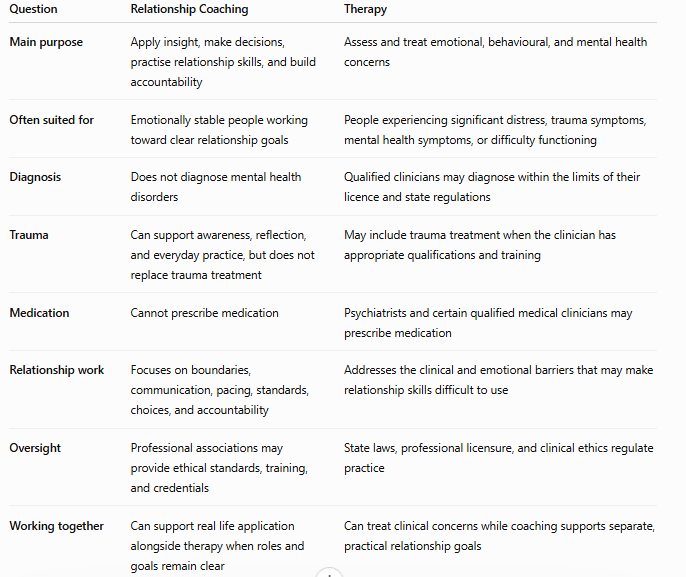
The cleanest distinction is this: coaching asks, “What will you practice?” Therapy may ask that too, but it can also assess and treat the symptoms or wounds that make practice alone insufficient.
Which Support Fits Common Relationship Patterns?
Limerence and Obsessive Romantic Focus
Limerence can involve intrusive thoughts, idealization, repeated checking, emotional dependence on another person’s attention, and a powerful hunger for reciprocation.
Research remains limited. A case study on cognitive behavioral treatment for limerence reported better functioning for one client after several behavioral and cognitive methods. A newer Limerence Questionnaire study identified an intense need for attachment and neglect of self and others as two central dimensions.
Coaching may fit when you can function in daily life and want help stopping the behaviors that feed the cycle. Therapy may be the better first step when thoughts feel uncontrollable, work or sleep is suffering, or the obsession appears alongside severe anxiety, depression, trauma symptoms, or compulsive behavior.
The question is not only, “How do I stop thinking about them?” It is also, “What part of my life becomes quiet when I am consumed by them?”
Anxious Attachment and Self-Abandonment
Anxious attachment can turn ambiguity into an alarm. A delayed reply may feel like rejection. A boundary may feel like abandonment. You may silence a need because keeping the connection feels more urgent than keeping contact with yourself.
A meta-analysis of adult attachment and mental health linked higher attachment anxiety and avoidance with more negative emotional states and lower positive well-being. A review of attachment under stress also describes different emotion regulation patterns. These are associations, not destiny.
Coaching can help you pause before seeking reassurance, communicate directly, date at a pace that lets evidence appear, and keep your values present when attraction becomes intense.
Therapy is usually wiser when abandonment fear brings panic, severe emotional swings, trauma responses, self-harm urges, or loss of daily functioning.
Avoidant Attachment and Fear of Intimacy
Avoidant patterns can look calm from the outside. Inside, closeness may feel like engulfment, obligation, exposure, or loss of self. You may want love until it arrives with needs. Then distance starts to feel like safety.
Coaching may help when you can see this movement and are ready to practice staying present. That might mean voicing a need before disappearing, tolerating vulnerability, or learning that autonomy and intimacy can coexist.
Therapy may be needed when closeness triggers dissociation, intense fear, traumatic memories, emotional shutdown, or a pattern so rigid that relationships repeatedly collapse.
Your shadow is not proof that you are incapable of love. It may be the part of you that learned distance was protection.
Recurring Emotionally Unavailable Partners
When unavailable partners keep appearing, uncertainty may feel familiar enough to register as chemistry.
Coaching can help you examine pacing, standards, projection, attraction, and the evidence you accept as intimacy. Therapy may be the better fit when the pattern is tied to trauma, deep shame, unresolved grief, compulsive repetition, or symptoms that cloud your ability to read safely.
This work is not about blaming you for another person’s emotional absence. It is about returning choice to the place where hope once took over.
Infidelity Recovery
Infidelity can fracture trust, identity, memory, and a person’s sense of what was real. An integrative treatment paper on recovery from infidelity describes it as an event that changes how partners interpret each other and their relationship. A randomized trial of couples therapy after an affair found that couples did not all respond in the same way. No single path guarantees repair.
Coaching may help a stable person clarify values, boundaries, and decisions. Therapy may fit when betrayal brings trauma symptoms, depression, anxiety, panic, or loss of functioning.
Couples therapy may fit when both partners are willing to examine the affair, take responsibility, and decide what the relationship can become. Sometimes the work creates repairs. Sometimes it creates a clearer ending.
When Couples Therapy May Be the Better Choice
Couples therapy treats the relationship pattern rather than naming one partner as the problem.
The American Association for Marriage and Family Therapy describes marriage and family therapy as mental health care that works with individuals, couples, and families through a relational lens. It may address conflict, emotional distance, communication, trust, intimacy, and recurring cycles.
Couples therapy may make sense when both partners want to understand the cycle, trust has been damaged, conflict repeats, intimacy has changed, or the couple is considering separation.
Abuse changes this recommendation. When coercion, intimidation, stalking, threats, or violence are present, standard couples therapy can increase risk. The National Domestic Violence Hotline advises against ordinary couples counseling with an abusive partner and recommends individual safety support instead.
Conflict is a shared pattern. Abuse is a use of power and control. They are not the same problem.
When Psychiatry Belongs in the Conversation
Psychiatry may be needed when relationship pain is occurring alongside symptoms that call for medical assessment, diagnosis, or medication.
The American Psychiatric Association defines psychiatry as the branch of medicine concerned with mental, emotional, and behavioral disorders. Psychiatrists are physicians who can evaluate physical and mental health, prescribe medication, and sometimes provide psychotherapy.
A psychiatric assessment may help when there is severe or persistent depression, disabling panic, major changes in sleep or behavior, mania, hallucinations, suicidal thoughts, symptoms with a possible medical cause, or a need to discuss medication.
Psychiatry and therapy are not rivals. Some people use them together, while others need only one.
When Coaching Is Not the Right First Step
Coaching should not be used to polish over a crisis.
Therapy, psychiatric care, emergency support, or specialist services should come first when there are suicidal thoughts, self-harm, severe depression, psychosis, mania, intense disorientation, active substance dependence, serious trauma symptoms, abuse, stalking, threats, or a need for diagnosis or medication.
The ICF referral resource lists major mood changes, decline in work or school performance, withdrawal, sleep disruption, hopelessness, suicidal thoughts, and psychological concerns that block coaching progress as signs that referral may be needed.
In the United States, call or text the 988 Suicide and Crisis Lifeline for crisis support. If you or someone else is in immediate danger, call 911.
Reaching for clinical care is not a failure of self-awareness. It is self-protection with the right level of support.
Can You Work With a Coach and Therapist at the Same Time?
Yes, when the roles are clear.
Therapy might treat trauma symptoms, depression, anxiety, or attachment wounds. Coaching might focus on dating choices, boundaries, communication practice, or applying what you have learned. Psychiatry might handle medical assessment or medication.
The work becomes muddy when two professionals are trying to treat the same concern without coordination or when a provider moves between coaching and therapy without naming the role. The ICF Code of Ethics requires professionals to disclose when they are acting in another role.
Ask what belongs in each service and how overlap will be handled. Clear boundaries make support safer.

A Practical Decision Guide
Start With Coaching When
You are functioning in daily life, feel stable enough to reflect, and want help applying insight to a clear relationship goal. You may need structure as you practice boundaries, discernment, communication, or new dating choices.
Start With Therapy When
Anxiety, depression, trauma, grief, compulsive behavior, or relationship distress is interfering with sleep, work, safety, self-care, or daily functioning. Therapy is also the better starting point when you need clinical assessment or treatment.
Consider Couples Therapy When
The concern lives in the interaction between you and your partner; both people can participate safely, and both are willing to examine their part in the cycle.
Consider Psychiatry When
Symptoms may require medical assessment, diagnosis, medication, or a review of physical health.
Begin With a Consultation When You Are Unsure
A responsible professional should discuss fit, scope, limits, and referrals without forcing every concern into the service they sell. The right first step does not have to become your forever step.
Finding the Right Path With Me
I am Olympia Georgeson, M.A., M.F.A., LMHC, LPC, and NCC. I am a licensed psychotherapist, relationship coach, poet, and former professor of the Study of Love.
My work joins psychology with language. I help people understand limerence, attachment wounds, emotional unavailability, self-abandonment, and the difference between intensity and intimacy.
Adults located in New York or Virginia can learn about individual therapy with me.
Those seeking structured support with relationship patterns and real-life application can explore private relationship coaching.
You may also explore The Aligned Love Course, a twelve-module educational experience about obsession, fantasy, attachment, nervous system patterns, communication, and secure love.
Still unsure which door fits? Contact me for an honest conversation about scope and fit.
Frequently Asked Questions
Is Relationship Coaching the Same as Therapy?
No. Coaching usually focuses on goals, practice, decisions, and accountability. Therapy is licensed mental health care that can assess and treat emotional distress, trauma, and mental health conditions. A therapist’s exact clinical authority depends on state law.
Should I Choose Coaching or Therapy for Anxious Attachment?
Coaching may fit when you are stable and want support in practicing boundaries, direct communication, pacing, and self-trust. Therapy may be a better starting point when attachment fear brings panic, trauma symptoms, self-harm urges, severe distress, or difficulty functioning. Attachment patterns describe tendencies, not fixed destinies.
Can Coaching Help With Limerence?
Coaching may help a stable client identify behaviors that feed limerence, reduce fantasy-based choices, rebuild neglected parts of life, and practice boundaries. Therapy should come first when obsessive thoughts feel uncontrollable, cause major distress, interfere with daily functioning, or occur beside depression, trauma, anxiety, or compulsive behavior. Clinical literature on limerence remains limited, so claims about one universal cure are not supported.
Do We Need Couples Therapy After Infidelity?
Couples therapy may help when both partners want to understand what happened, examine responsibility, rebuild trust, and decide whether the relationship can continue. Individual therapy may also be needed for trauma symptoms, depression, anxiety, or grief, while coaching may support a stable person making values-based decisions. Research suggests that couples respond differently after an affair.
Can I Receive Therapy From Olympia Anywhere in the United States?
My therapy services are currently listed for adults located in New York and Virginia, where I am licensed. People outside those states can review my coaching and educational options or contact me to discuss which service may fit their goals.View my therapy page for current details.